1.What the standard says
ASC 340-40 covers costs to obtain a contract. The rule: incremental costs of obtaining a contract that you expect to recover are capitalized as an asset and amortized on a basis consistent with the transfer of the goods or services. Incremental means the cost would not have been incurred if the contract had not been won. A sales commission paid on a signed deal is the textbook example.
Two things are not incremental and stay as expense: base salary, and costs you would have paid anyway such as a bonus for hitting a team target that does not depend on any particular contract. Whether an accelerator or a quota bonus is incremental is a judgment your auditors will have a view on; most firms treat commission tied to specific bookings as capitalizable and plan-level bonuses as period expense.
2.Over what period
The amortization period is the period of benefit, which is usually longer than the contract. If a two-year contract is expected to renew twice and the renewal commission is not commensurate with the initial one, the asset amortizes over the expected customer life, often four to six years. If a renewal commission is commensurate, each contract is its own asset over its own term.
The practical expedient: if the amortization period would be one year or less, you may expense the cost as incurred. Many companies apply it to one-year deals and capitalize multi-year ones, which means the policy has to be applied deal by deal.
3.Why it must read the paid ledger
The asset is the commission actually paid or payable on the deal, not the commission the plan calculates today. If the plan is re-run and a clawback reduces a rep's commission, the asset for that deal changes, and that change has to flow into the schedule as an adjustment in the period it happened, not as a silent restatement of the original.
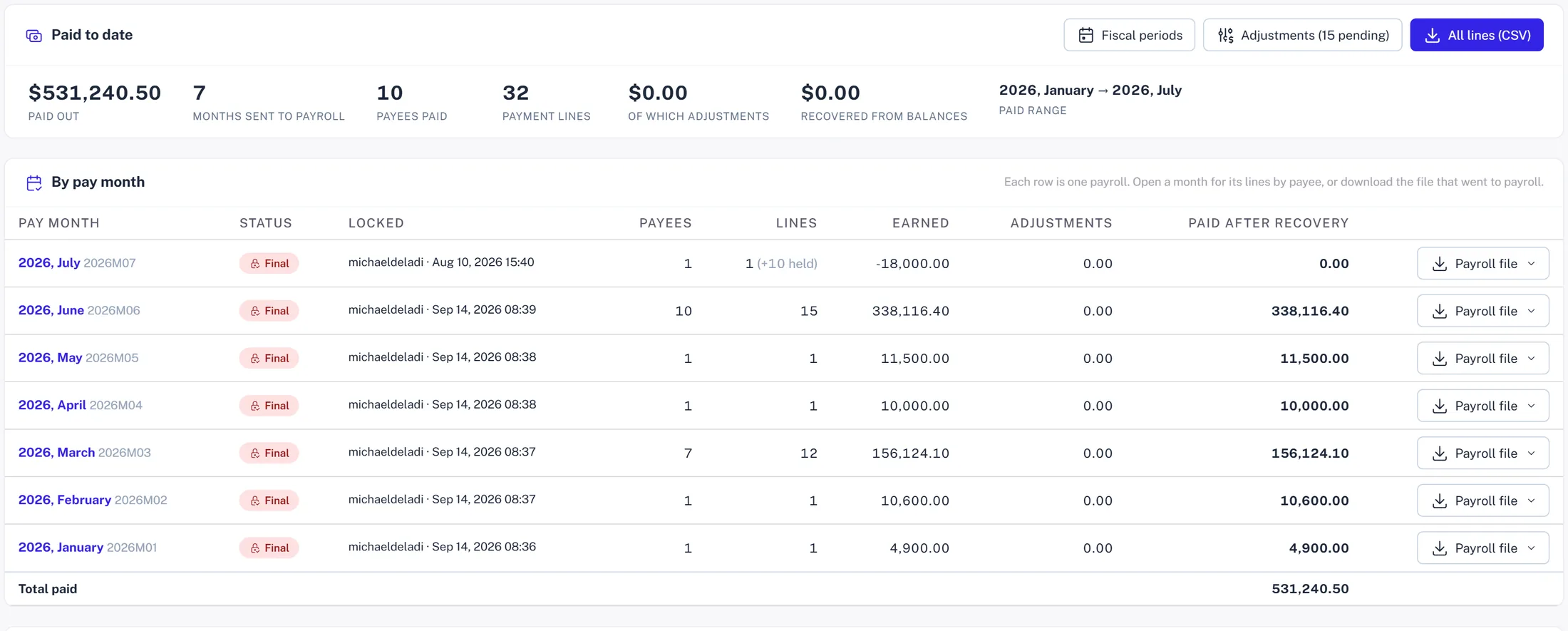
So the capitalization calculation reads the locked payment lines, the record of what went to payroll each month, by payee, plan and component, and the deal grain behind them: the opportunity, the contract start and duration, the deal type. A calculation that reads the live run instead will drift every time the run does.
4.The mechanics
A workable policy engine does four things, and each should be a table a controller can read, not code.
- ✓Scope: which components are incremental (rules by component, plan, deal type and contract length), and which fall under the one-year expedient.
- ✓Allocation: split each paid line across the deals that earned it, to the cent, with a largest-remainder rule so the pennies reconcile.
- ✓Schedule: straight-line over the period of benefit from the contract start, with a catch-up in the booking month when the commission was paid after service began.
- ✓Adjustments: a later change to a paid line, a clawback or a correction, produces a schedule change in the month it happened, never a rewrite of earlier months.
5.Controls the auditor expects
A capitalization run is a journal entry waiting to happen, so it needs maker-checker: the person who runs it is not the person who approves it. The audit pack checks exactly that and flags a self-approved run as an exception. Every policy change, every override and every run is in the change log with who and when.
Keep the policies, the allocation and the schedule as tables you can export. The auditor will sample deals and walk them from booking to the balance sheet, and the fastest audit is the one where that walk is four lookups.
6.Common mistakes
- ✓Capitalizing from the calculation run instead of the paid ledger, so the asset moves every time comp ops fixes a split.
- ✓One amortization period for everything, when the expected customer life differs by segment or product.
- ✓Forgetting the catch-up when commission is paid months after the contract started.
- ✓Netting clawbacks into the current month's additions instead of showing them as a reduction with its own trail.
- ✓A spreadsheet owned by one analyst, which is a key-person risk in a SOX control.