1.Never rewrite a paid month
The single most important rule in commission accounting is that a month that was sent to payroll is history. If your system recalculates March in June and silently changes March's numbers, you have three problems: the rep's March statement no longer matches what they were paid, finance's March accrual no longer matches the ledger, and the auditor cannot tell what March was.
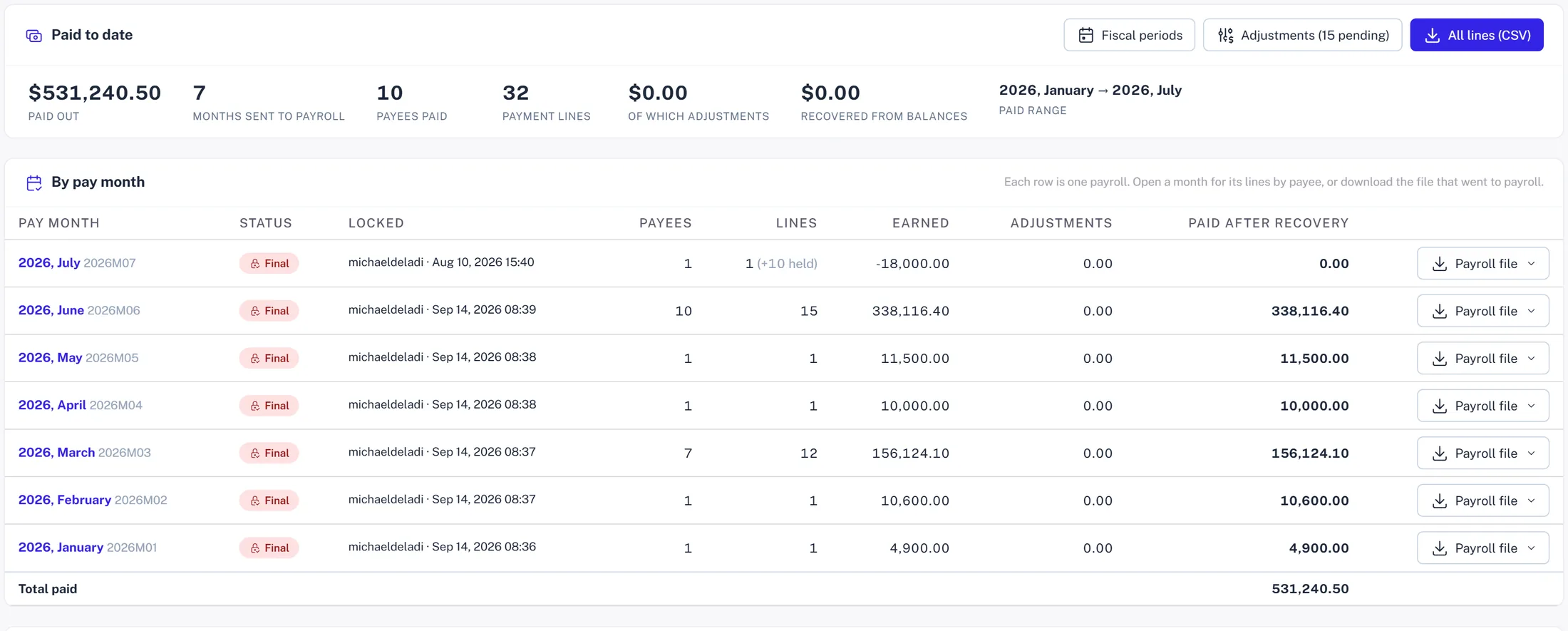
The fix is a lock. Locking a month takes a snapshot of every payment line, by payee and by component, at the moment it went to payroll. That snapshot is what was paid. Every later calculation is compared against it; it is never overwritten.
2.Adjustments by component, in the next open month
When today's calculation for March differs from what was paid for March, the difference is a prior-period adjustment. It pays in the next open month, as its own line, tagged with the month it corrects and the component it belongs to. A cancelled deal that reduces the ACV commission by $1,200 shows up as a negative $1,200 ACV adjustment, not as a smaller total nobody can explain.
By component matters because components have different rules. A clawback on a new-logo kicker should not quietly net against an unrelated bonus. Keeping them separate also means the rep's statement, finance's accrual and the payroll file all tell the same story.
3.Review anything above a threshold
Adjustments are where mistakes and bad actors hide, so they get a control of their own. Any manual or prior-period line above a review threshold needs an approved adjustment review before the month can pass its audit. Pending reviews hold the control at 'review'. The threshold is yours to set.
On the rep side the same adjustment appears on the statement with its explanation attached: which deal, what changed, which month it corrects. Most disputes end there.
4.Clawbacks are adjustments with a policy
A clawback is a negative adjustment that the plan said in advance could happen. Whether you can recover it, and how, is a legal and HR question that varies by state and country. What the system can do is make the mechanics unambiguous: the negative line, the month it corrects, the deal behind it, and the running balance if recovery is spread over several pay periods.
Payroll files can carry negatives as signed amounts or as an absolute value with a separate sign column, depending on what the HR system accepts. Earnings codes can map adjustments to their own code so payroll sees them as corrections, not as new commission.
5.Wording the policy
Put the rules in the plan document the rep signs, not in a wiki. The clauses that matter most:
- ✓What triggers a clawback: cancellation or non-payment within a stated window, a correction to credit, a split re-assignment.
- ✓The window: typically 90 to 180 days after booking, or until the first invoice is paid, with the clock stated plainly.
- ✓How it is recovered: against future commissions first, over how many pay periods, and what happens at termination.
- ✓That corrections to a paid month are paid as adjustments in a later month and never change the paid statement.
- ✓Where the rep can see the calculation and how to raise an inquiry, with the response time limit.
6.What the auditor sees
Because the lock is a snapshot and adjustments are separate lines, the audit pack can state three things for each period: the number that was paid, the adjustments that were paid later with their reviews, and the input changes that arrived after the lock and are still to be paid. Nothing has to be reconstructed.
The plan documents the reps signed are in the same pack, so the policy and the practice are in one place.