1.Top-down, bottom-up, and the argument in between
Top-down starts from the company number and divides. Bottom-up starts from what each territory can do and adds. Every real quota process is both: finance cascades a number down, sales pushes a capacity number up, and the plan is the negotiation. The tool's job is to make the cascade fast enough to run many times, so the argument is about assumptions rather than arithmetic.
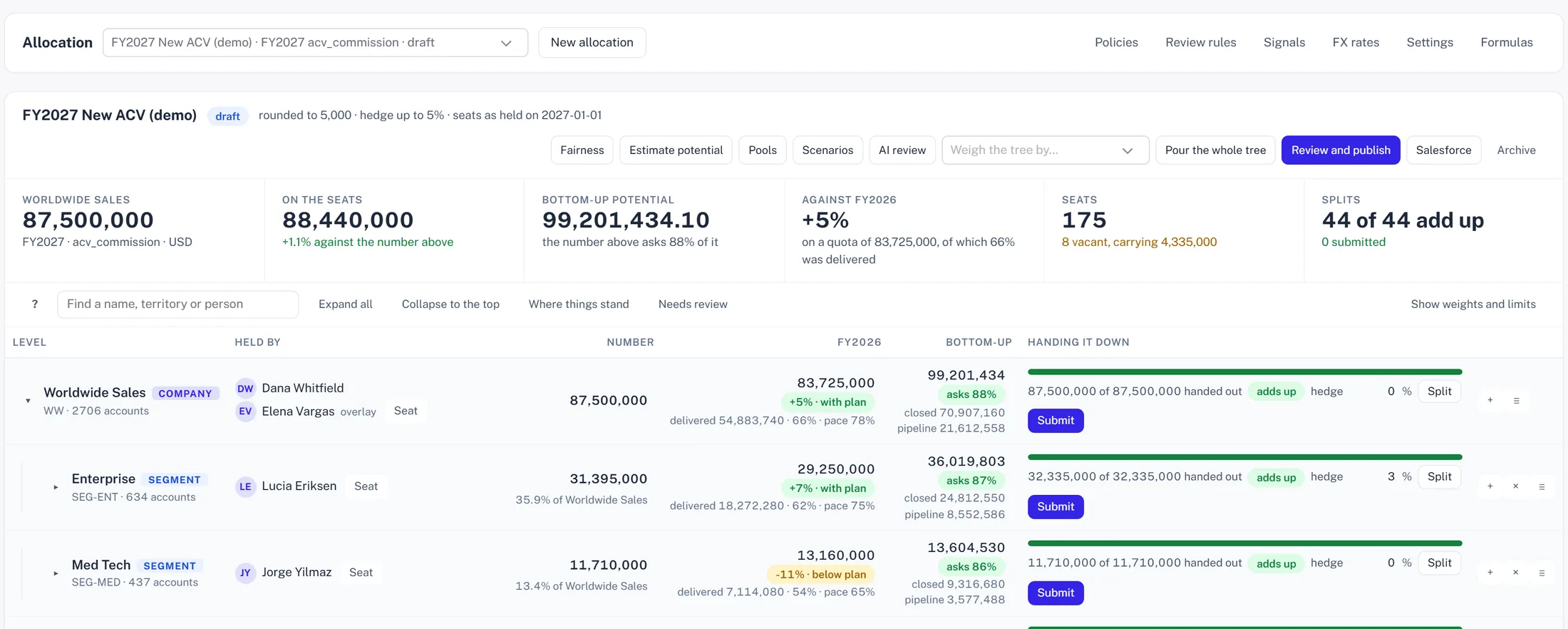
The cascade on the demo book follows the territory tree: company, region, segment, team, rep. Each node gets a share of its parent. A manager can split their own node among their reports. Nothing is final until the plan is published.
2.Allocating down the tree
Start each level with a default split, usually last year's actuals or the territory's weighted pipeline, then let the owner of that node adjust. Shares at a level must sum to the parent, and the page refuses a publish while they do not. That one constraint is what keeps the number honest all the way down.
A hedge percent per node handles over-assignment: the sum of the children can exceed the parent by the hedge, so a region can assign 105 percent of its number to cover expected attrition. The hedge is capped per allocation and visible, because a hedge nobody can see is how quotas inflate.
3.Proration is a policy, not a spreadsheet column
Reps join in April, go on leave in August, leave in October. Each needs a quota for the time they held the seat. Doing this by hand is where quota plans go wrong, so write the policy once and let the system apply it:
- ✓Unit: prorate by days, months, quarters or halves.
- ✓Partial unit: a month counts if any day is held, if the start is before the midpoint, or not at all. 'After the 15th goes to next month' is a midpoint rule.
- ✓Terminations end the quota on the termination date.
- ✓Leaves longer than a minimum, say 30 days, are excluded from the held time; shorter ones are ignored.
- ✓The result is a sentence on every row: 'x 41.7% of the year by months, 5 of 12, ended 9 Aug, terminated'.
4.Overrides, with a reason
The policy will be wrong for someone. A rep who covered two territories for a quarter, a maternity leave the HR feed recorded a month late. Let the comp team override a computed quota, require a reason, show the computed number beside the override, and write the change to the audit log.
Overrides that persist through re-publishes are the other half of this. If the next cascade silently resets a negotiated quota, nobody will trust the tool.
5.From the plan to the payout
The published quota is not a report. It is the number the compensation plan reads when it computes attainment. The same proration policy that set the annual quota has to apply to each pay period, so a rep hired in April is paced against eight months, not twelve, and the plan document they sign states the prorated figure.
This is the join most tools miss: planning in one system, paying from another, and a quarterly reconciliation to find out they disagree.
6.Make it an afternoon
A cascade that re-runs in seconds changes the meeting. Finance proposes a split, sales counters, the room sees the rep-level result and the proration sentence for every hire on the roster before anyone leaves. Publish, issue the plan documents, and the reps sign quotas that already add up to the number the board gave you.